
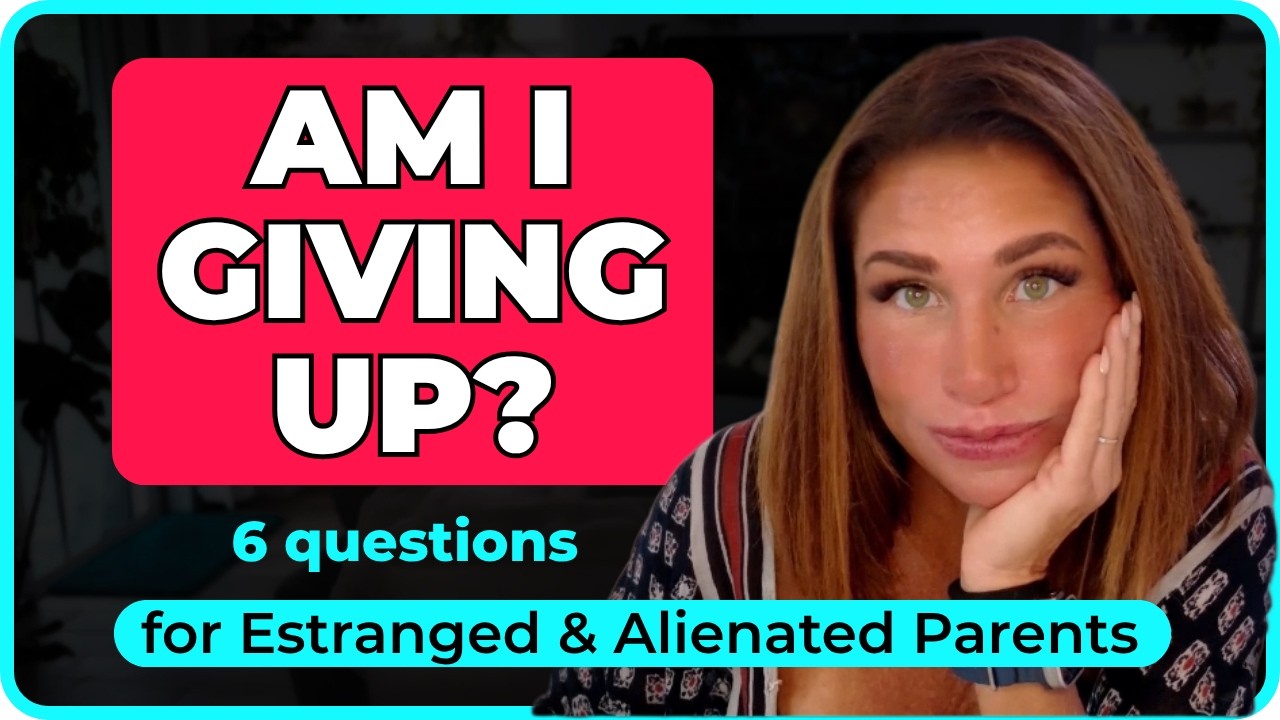
Shelby Milford | Beyond the High Road Podcast, Episode 205
If you fight every custody infraction, every hostile text, and every attempt to provoke, you risk feeding the narrative that you are the high-conflict parent. On the other hand, if you continually back down in order to keep the peace, you may slowly disappear from your child's life — or from your own.
Damned if you do, damned if you don't. This is every alienated parent's reality.
If you've been navigating parental alienation, forced estrangement, or a high-conflict co-parenting relationship, you already know this impossible bind. Every choice appears to carry a monumental consequence. Enforce the court order and your child responds with anger and rejection. Stay quiet and the story morphs into "you don't care." Look up a year later and you've been pushed even further out of your child's life.
So how do you make decisions when there may be no perfect external outcome?
This is the question we've been exploring across our four-part series on reclaiming your agency after alienation.
-
In Part 1, we covered the passive bow out — how targeted parents quietly withdraw without realizing it.
-
In Part 2, we explored the internal prison of self-punishment — how we turn the pain of alienation inward.
-
In Part 3, we talked about stepping out of the crisis loop — the pattern of reactive, survival-mode living that keeps you stuck.
Today, in the finale, we bring all of that into the actual decisions you're forced to make every single day: in your co-parenting relationship, in your legal situation, and ultimately, in your relationship with your child.
---
The Core Question: Who Am I Being in This Choice?
Here's the reframe that changes everything. Stop asking only should I fight this or let this go? and begin asking instead:
Who am I being in this choice?
Two parents can make the exact same decision for entirely different reasons. One may be abandoning herself because she feels powerless and frightened. The other may be consciously honoring the limits of her financial, emotional, legal, or physical capacity. The external action looks identical. What's underneath it is everything.
The question is not simply do I continue fighting? The question has to be: what is driving my choice, and what is this choice creating inside of me?
---
Wise Surrender: Consciously Releasing Control
Wise surrender is a conscious decision to release your fight with something that you can't control — or no longer choose to try to control.
It may mean:
- Not responding to a hostile email
- Dropping a relatively minor custody infraction
- Releasing your expectation of a particular response from your child or the other parent
- Choosing not to pursue further legal action
- Accepting that someone may continue telling a false story about you
- Recognizing that a particular effort is costing you more than you can healthily continue to give
The choice comes from emotional adulthood, grounded strength, and honest capacity. It comes from a non-resistance to reality.
It may still hurt tremendously. You may still grieve what you are releasing. But the decision itself does not require you to make yourself smaller.
Wise surrender releases control, but it does not relinquish yourself.
---
Fear-Based Retreat: When Fear Makes Your Decisions After Alienation or Forced Estrangement
Fear-based retreat happens when fear, guilt, rejection, or the need to prevent someone else's anger begins making your decisions for you.
You may give up something deeply important to you — not because you've consciously decided the fight is no longer healthy, but because the emotional discomfort of continuing feels almost unbearable.
It sounds like:
- "I don't want to make my child angry."
- "I can't bear to be rejected again."
- "Every time I call, they just hang up on me anyway, so what's the point?"
- "If I say no, they'll tell my child that I don't care."
- "If I just don't rock the boat, maybe they'll eventually soften."
None of those thoughts are wrong or false. It's about your motivation. Are you releasing control, or are you trying to outmaneuver your own pain?
In fear-based retreat, we always surrender in advance — because we are attempting to outmaneuver our own pain. In wise surrender, we consciously release a particular outcome without using that release as another way to erase ourselves.
---
Compassion Does Not Require Participation
When you love your child and understand the trauma influencing their behavior, it's incredibly easy to use that understanding as a reason not to enforce boundaries.
You tell yourself: They've been through so much. They're being manipulated. I have to be the safe parent. I need to show them my love is unconditional.
All of those things may be true. But understanding why someone is behaving in a harmful way does not mean you must remain endlessly available for that behavior.
Compassion does not require participation.
Sometimes we unintentionally weaponize our own empathy against ourselves. We use our ability to understand everyone else's pain as evidence that we don't need to have any limits, boundaries, or needs of our own.
Continuing to absorb mistreatment is not necessarily an expression of unconditional love. That's not the requirement of unconditionally loving someone — to just absorb it all, to be the sponge. Sometimes, many times, it's an attempt to control the outcome through self-sacrifice: If I endure enough, maybe this will finally change them.
That can become self-punishment disguised as devotion.
Unconditional love does not require unconditional access to mistreat you.
---
Reframing Mistreatment to Empower Your Perspective
When you're safe — when you're no longer under someone's abusive behavior — you get to decide how you want to think about what happened. You get to decide how you want to think about all of it.
It's common in the anger stage for alienated parents to say, "They're mistreating me. They're being disrespectful. They're abusing me." And while that may be true, holding onto that framing can end up further victimizing you.
Ask yourself: How do I feel when I think that they're mistreating me? Is it working for me? What is that thought causing inside of me? What is my experience after that?
The abuse or mistreatment remains the responsibility of the person choosing it. You did not cause it, and you were not responsible for making it happen. But you are allowed to become curious about where you may still be making yourself available for it — and whether that framing is serving you or keeping you stuck.
---
My Experience on Both Sides
I've made decisions from both places. I've made hundreds of choices out of fear — surrendering because I was scared of the blowup, the retaliation, the fallout.
I dragged my feet on going back to court because I was terrified of how it would affect my daughter — but honestly, I think I just couldn't face the shame and humiliation of being in that courtroom. That was shame speaking. And my rule has always been: never make decisions from a place of fear or shame. If I'm there, I wait.
I slinked out of school functions to avoid conflict. I hid behind crowds at recitals. I learned how to apologize for breathing, for taking up space. I became smaller and smaller. Those decisions did not bring me peace. They ate away at my self-worth.
But I've also made decisions that looked like surrender from the outside but were anything but. I stopped engaging with hostile emails — not out of fear, but because I chose not to opt in to the drama anymore. I moved halfway across the country. And perhaps the biggest surrender of all: I chose to love what my daughter loved, even when that meant opening myself to the reality that she actively loved people who had abused both her and me.
Those decisions came from emotional adulthood, non-resistance, and unconditional love. They did not make me smaller. If anything, they returned me to myself.
That's why we can't determine whether a choice is wise surrender or fear-based retreat just by looking from the outside. We have to look at what's underneath it, and what it creates inside of us.
---
Real-Life Scenarios: What It Looks Like in Practice
Scenario 1: Your Child Refuses Parenting Time
Your 13-year-old texts Thursday night: "I don't wanna come to your house this weekend. It's too stressful."
Fear-based retreat: You immediately say, "Okay sweetheart, you can stay there" — because you're terrified of the hostility and rejection they'd bring into your home for 48 hours. You surrender the whole weekend before it begins because the anticipation of pain feels unbearable.
Wise surrender: You respond calmly: "I hear that you're feeling stressed. Our plan is still for me to pick you up at 5:00 PM tomorrow, and we'll take things from there." You aren't arguing with their feelings, but you also aren't letting those feelings — or your fear of them — make the entire decision. If they refuse to come, you don't create a tug-of-war at the curb. You say, "I love you. Our time together still deeply matters to me. I'm going to keep coming around, and my doors are always open." Then you go home and document what happened.
You release your ability to control what happens at the curb without pretending the loss of your parenting time doesn't matter — and without making them responsible for your feelings.
Scenario 2: The Other Parent Changes Your Holiday Plans
Two days before Thanksgiving, the other parent texts: "The kids want to go to my family's cabin. Since it's what they want, I assume you won't be selfish and ruin their holiday."
Fear-based retreat: You give in, send a long paragraph about how unfair it is, then spend Thanksgiving alone staring at an empty table, searching social media for evidence of what you're missing. You choose the predictable pain of a lonely holiday because it feels less frightening than the uncertainty of holding the boundary.
Wise surrender: You review your court order and respond factually: "Per our court order, Thanksgiving is my parenting time this year. I will be at the designated exchange location at 9:00 AM on Thursday." If the other parent violates the order, you resist the urge to make an impulsive escalation to discharge your panic. You document. You consult legal support. You may ultimately be forced to surrender that day — but you don't surrender your rights, your dignity, or your parental identity in advance, simply because someone threatened to call you selfish.
You release your need to control the story the other parent tells about your decision. And that will buy you so much freedom.
Scenario 3: Ignored Phone Calls
Your court order stipulates a 15-minute call every Tuesday and Thursday. For weeks, your calls go to voicemail or your child grunts for 30 seconds and hangs up.
Fear-based retreat: You stop calling. You tell yourself your child hates speaking to you, that hearing your voice only makes them miserable. Stopping protects you from the immediate sting of rejection — but it also creates the appearance that you stopped trying.
Wise surrender: You surrender the expectation of a warm, meaningful conversation. But you do not surrender the consistency of your presence. You call at the scheduled time. When it goes to voicemail, you leave a brief, pressure-free message: "Hey kiddo, I'm calling to say I love you. I hope you had a great Tuesday. No need to call me back unless you feel like it. Have a good week."
You allow them to show up however they show up — without using it as evidence that you don't matter or that you should disappear. How they show up is entirely independent of whether you show up and how you show up.
I did this with my own daughter's Zoom calls. She'd stonewall me — tight-lipped, rigid, silent. I decided to just become the kid: full of energy, excited, asking about her vacation, her favorite parts. Within minutes, she'd crack a smile. By the end, we'd be laughing together. It worked because I based it on how I was choosing to show up, not on how she was showing up.
Scenario 4: Financial Pressure
You're repeatedly asked to pay for luxury items, cars, tuition, trips — expenses you can't healthily afford, or don't want to afford. You fear that saying no will allow the other parent or your child to claim you don't care.
Fear-based retreat: You keep paying — not because the spending reflects your values or financial capacity, but because you're attempting to purchase protection from a painful narrative. You want to prove them wrong, prove you're loving. I did this too: I spent over $250,000 in court proceedings, depleting every pocket I could find, all in the hopes it would change the situation. It didn't.
Wise surrender: You review your legal obligations, your values, and your actual financial capacity. You contribute where it's appropriate and healthy. When it's not, you give a calm, loving, firm: "No, I can't do that now." You don't need to explain yourself beyond that. You surrender your ability to control what the other parent says or what your children think about your decision. But you do not surrender your financial stability in an attempt to prevent them from thinking or saying anything.
---
The 6-Question Audit: Am I Wisely Surrendering or Retreating from Fear?
When you're unsure, ask yourself:
1. What is driving this choice? Is it love, clarity, capacity, and acceptance — or fear, guilt, rejection, shame, and the urgent need to stop someone's anger?
2. What am I actually trying to protect? Am I protecting my child from unnecessary harm, or am I protecting myself from the discomfort of their anger, rejection, or disappointment?
3. What am I hoping that my suffering will accomplish? Am I enduring mistreatment because I secretly believe that suffering enough will make someone recognize my love and finally change?
4. What is this choice creating inside of me? Does it leave me grieving but still grounded and intact — or does it leave me feeling small, ashamed, erased, and disconnected from myself?
5. What am I surrendering? Am I releasing my attempt to control an outcome I cannot force — or am I relinquishing my dignity, my values, my identity, or my healthy limits?
6. Is this a conscious pause or a permanent disappearance? Am I preserving my capacity so I can remain present for the long game — or am I withdrawing ahead of time to avoid pain?
---
The Distinction That Changes Everything
Wise surrender is not giving up. It's releasing your fight with the parts of reality that you cannot control — without releasing yourself, without erasing yourself.
Fear-based retreat is not evidence that you are weak or that you have failed. It simply shows you a place where fear may have begun making your decisions for you. Once you can see that without punishing yourself, you can choose again.
Wise surrender means releasing your demand that another person change their ways. Self-abandonment means continuing to sacrifice yourself in hopes that they will change.
You do not need to win every battle to honor your role as a parent. And you don't need to erase yourself to prove that your love is unconditional.
The boundary isn't to control what's outside of the fence. The boundary is for what's inside — for you.
Understanding someone else's behavior may help you stop fighting reality, but it does not obligate you to remain available for that behavior. Please don't use your own heart, your empathy, your compassion as evidence that you should not have boundaries. Those two things are independent.
Keep doing the quiet work of caring for yourself. Keep moving forward.
---
Resources Mentioned in This Episode
- Part 2: The Internal Prison of Self-Punishment
- Part 3: Stepping Out of the Crisis Loop
- Coming next: The Easter Eggs of Reconnection and The Path of Least Resistance
---
Shelby Milford is a twice-certified life coach specializing in post-traumatic growth and the host of the Beyond the High Road podcast. If you're experiencing the effects of alienation and you're ready to heal, this show is her love letter to you. Subscribe wherever you listen, and follow on TikTok and Instagram for bite-sized clips and tips.
---